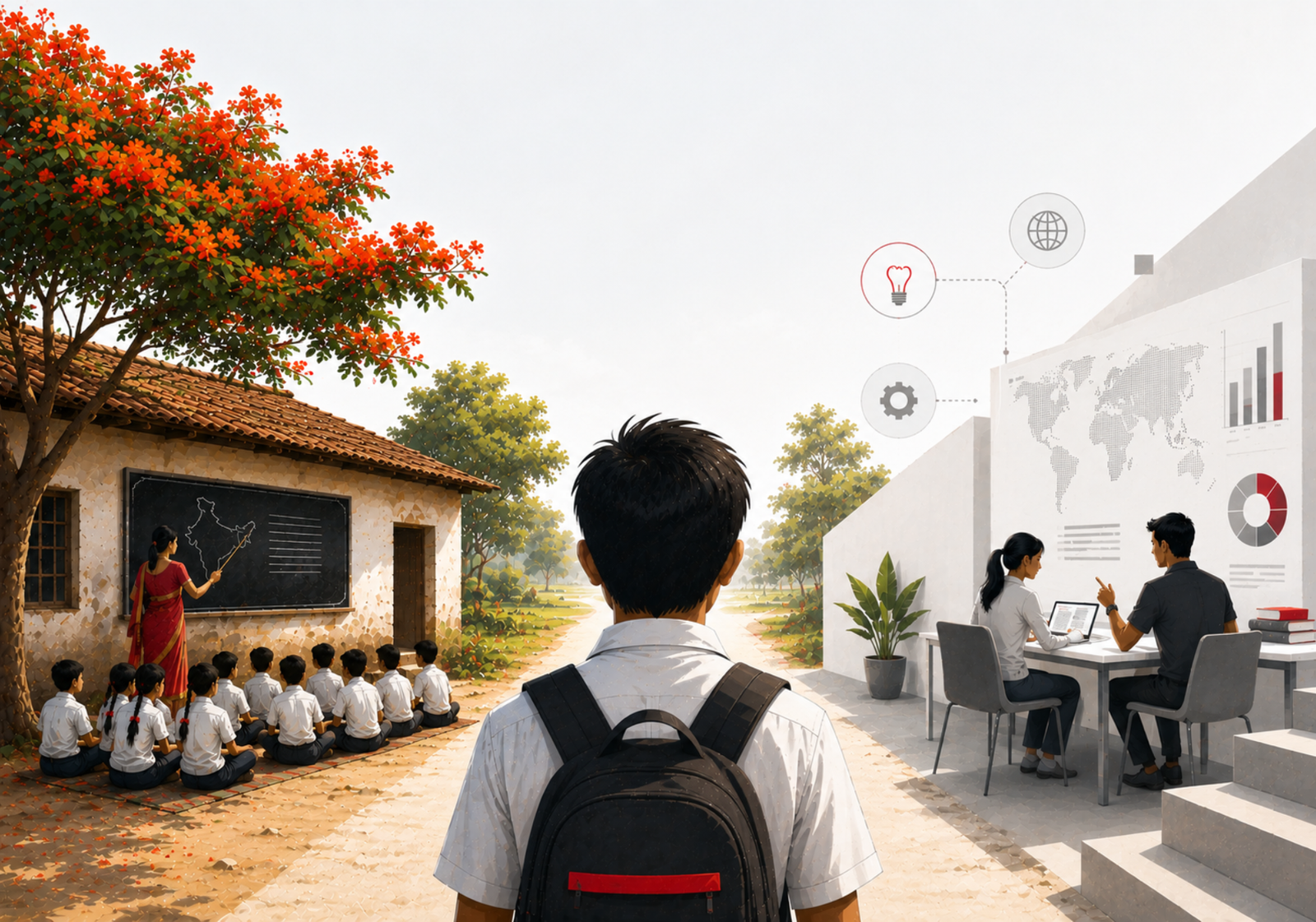
In a government primary school in rural Bihar, a teacher divides forty-odd children into three clusters, not by grade, but by what they can actually read. The single functioning bulb in the room burns over the group still struggling with the alphabet. There is no computer here, and there hasn’t been one for years. A hundred and fifty kilometres away, in Patna, a hoarding above a flyover advertises an “AI-powered personal tutor” that promises to spot a child’s learning gaps “in real time.” Both scenes are happening in the same state, in the same year. Only one of them is where the capital is going.
That contrast is the real story of Indian education right now, not the AI story everyone is writing.
For two years, India’s edtech industry and its education-policy conversation have run on parallel tracks that rarely meet: one enthusiastic, well-funded, almost entirely about artificial intelligence; the other the plain infrastructure of learning — electricity, a working computer, a stable connection, a teacher who shows up — still unfinished business for roughly a third of the country’s schools. The question worth asking isn’t whether AI belongs in the classroom. It’s whether India is solving the problem it already has, or the problem that happens to be fundable.
The gap the algorithms can’t see
Start with what exists on paper. The government’s own UDISE+ 2024-25 report, the annual census of India’s 14.7 lakh-plus schools, records real, measurable progress: electricity access up to 93.6 per cent from 91.8 per cent the year before, computer availability up to 64.7 per cent from 57.7 per cent, internet connectivity up to 63.5 per cent from 53.9 per cent. Read quickly, that looks like a system closing its gaps.
Read the same report closely and it says something else. Close to five lakh schools, a third of the total, still have no computer or internet — down from about six lakh the year before, but still a third. By the report’s own numbers, that leaves close to ninety-four thousand schools without reliable electricity. Nor is the gap evenly spread: Education Ministry data shows rural schools trailing urban ones by up to twenty-nine percentage points on internet connectivity alone. That’s not a rounding error — it’s the base any classroom AI product needs to run on, and for a third of India’s schools, that base doesn’t exist.
Now set that against the direction of private capital — or what’s left of it. Global edtech venture funding peaked at $16.7 billion in 2021 and crashed to roughly $2.4 billion by 2024, a decade low, per HolonIQ, the industry’s own tracker; it fell further, to $1 billion in the first half of 2026, down 26 per cent year-on-year. Yet the money that’s left has a clear address: trackers agree it is concentrating in AI-enabled, workforce-aligned products — precisely what’s advertised on that Patna flyover — while general K-12 startups go unfunded. India has minted seven edtech unicorns and, this year, more than 1,400 funded education companies. One estimate puts the global AI-in-education market at $9.58 billion in 2026, headed toward $136.79 billion by 2035; others put 2035 closer to half that, but no forecast points the other way. A shrinking industry is still choosing AI over access.
The mismatch should be obvious, but it is worth stating plainly. The products chasing that valuation are built overwhelmingly for a child who already owns a smartphone, has a data connection, and is enrolled in a fee-paying test-prep pipeline — not for the child in the Bihar classroom with one working bulb.
What actually moved the needle
Here is the part that should embarrass the AI-in-education narrative more than it has. The one number in Indian education that genuinely improved this year had nothing to do with artificial intelligence. The ASER 2024 survey, which reached nearly 6.5 lakh children across almost eighteen thousand villages, found that Class 3 government-school students able to read a Class 2-level text rose from 16.3 per cent in 2022 to 23.4 per cent in 2024, the highest since the survey began, while those able to do basic subtraction rose from 20.9 per cent in 2018 to 27.6 per cent in 2024. That recovery, ASER shows, is driven almost entirely by government schools, not private ones, through low-tech, high-discipline interventions such as foundational-literacy pushes and small-group teaching pitched to each child’s level: the same unglamorous method visible in that Bihar classroom.
Private schools, meanwhile, the more plausible early home for AI adoption, are still recovering more slowly than they were before the pandemic. The evidence points in the opposite direction from the funding. What worked was pedagogy and grouping, delivered by a present teacher, not a personalised algorithm.
To be fair to the optimists, the case for AI in Indian classrooms isn’t fantasy. India has a genuine, chronic teacher shortage, and a well-designed tutoring tool, deployed at scale, could in theory stretch scarce good teaching further than the system manages today. That argument deserves to be taken seriously, not waved away as Silicon Valley hype. But “in theory” is doing a lot of work in that sentence. ASER’s own 2024 digital-literacy data is instructive: nearly 90 per cent of rural teenagers report a smartphone at home, but personal ownership is far lower, just 27 per cent of 14-year-olds and 38 per cent of 16-year-olds own one, and of those who can use a phone, only 57 per cent used it for anything educational the week before the survey. A shared device is not the same infrastructure question as a functioning computer lab.
None of this means AI has no place in Indian education. It means the industry building “the future of learning” has, with a few honourable exceptions, aimed its capital and imagination at the child who was already going to be fine — while the system’s actual crisis, roughly half of Class 5 students unable to read a Class 2 text, a third of schools with no computer to run any of this software on, is left to government budgets moving a percentage point at a time.
The teacher in that Bihar classroom doesn’t need a personal Einstein. She needs a second bulb, a working computer, and a curriculum that trusts what already worked in 2024. Everything else is a pitch deck.