
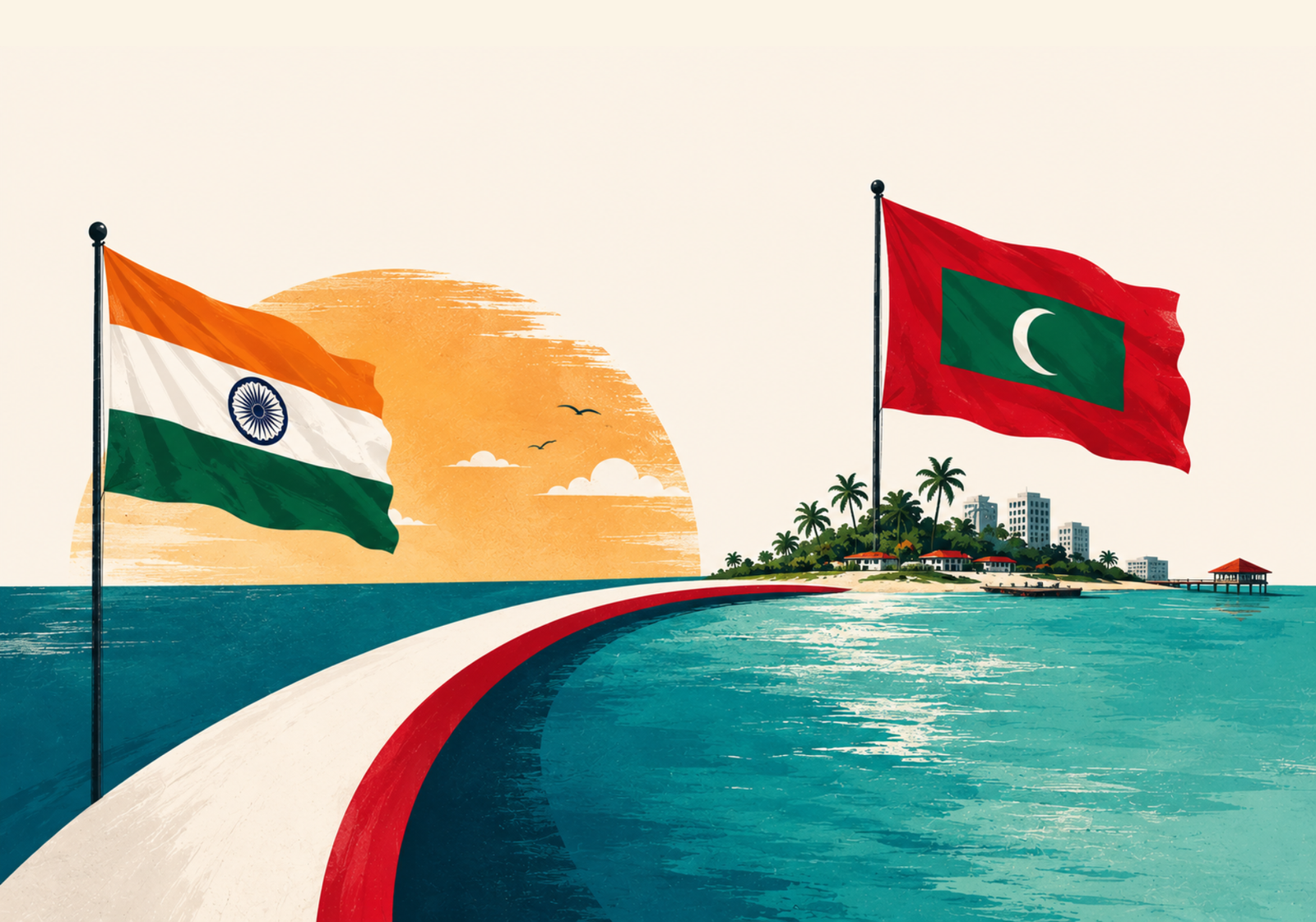
In November 2023, Mohamed Muizzu won the Maldivian presidency running on two words: “India Out.” His coalition partner, former president Abdulla Yameen, had been chanting some version of that slogan since 2021, when a secretive Indian-funded coast guard harbour project first drew accusations that New Delhi was quietly militarising the archipelago. Muizzu pledged to expel the roughly 80 Indian military personnel then stationed there (51 were gone by 7 May 2024, the final 27 three days later), signed a military assistance pact with Beijing that March, and picked Turkey and then China for his first state visit instead of Delhi. Every Maldivian president since multiparty democracy arrived in 2008 had gone to India first. Muizzu skipped it.
What’s happened in the three years since isn’t really one story about a payment corridor. It’s five stories running in parallel, and almost none of them made it onto a Maldivian ballot.
Everything Else Came Back First
The corridor that gives this piece its hook, the Favara-UPI cross-border payment corridor, went live on 30 July 2026, linking Malé’s domestic instant-payment system directly to India’s UPI so that a Maldivian worker can send rufiyaa home, or pull in rupees from family in India, as a real-time transfer through Bank of Maldives or Maldives Islamic Bank. No correspondent bank, no multi-day wait, roughly ten days of testing from signed agreement to live transactions. It’s a genuinely useful piece of financial plumbing. It is also the last of five things India rebuilt in the Maldives, not the first.
The oldest of the five predates Muizzu entirely. In February 2021, India signed a roughly $186 million agreement to build a coast guard harbour and dockyard at Uthuru Thila Falhu, awarded to the Indian public-sector firm Rail Vikas Nigam Limited and later nicknamed the Ekatha Harbour. It was meant to make the Maldives National Defence Force self-sufficient in ship maintenance, and it was widely read, correctly, as India beating China to a strategic foothold. India handed over a ten-station coastal radar network the following year, well before Muizzu had even declared his candidacy. None of this required a Maldivian government to publicly love India. It only required one that hadn’t yet found a cheaper alternative.
That’s the striking part: even after Muizzu did find one, the work didn’t stop. The Indian Navy carried out a full refit of the coast guard ship Huravee at its Mumbai dockyard between November 2024 and April 2025, gratis, with 72 more military vehicles handed over the following July.
The second thread is concrete. The Greater Malé Connectivity Project, a $500 million bridge-and-causeway link connecting the capital to three outlying islands, funded through a $100 million grant and a $400 million line of credit from India’s Exim Bank, is the single largest foreign-funded infrastructure project in Maldivian history. Its centrepiece, the Thilamalé Bridge, was originally due in 2026. It’s now expected in 2027. Delays and all, it’s still moving, still Indian-funded, and still the biggest thing any foreign government has ever built in the country.
The third thread is money, and it moved in two visible instalments after the freeze began to thaw. In October 2024, on Muizzu’s first state visit to Delhi, the Reserve Bank of India signed a $750 million currency swap with the Maldives Monetary Authority, RuPay cards went live in Malé, and Muizzu called India a “valued partner.” In July 2025, Modi flew to Malé as guest of honour at the Maldives’ 60th independence celebrations, the first Indian prime minister ever invited to do so, and signed off on a fresh $565 million line of credit plus a 40 per cent cut to Maldives’ annual debt repayments to India. The same visit produced the agreement behind the Favara-UPI corridor and launched the first round of talks on a free trade agreement. Muizzu called India a “trusted friend” this time.
Add it up and the corridor isn’t really the story. It’s the last domino in a sequence that started with a naval dockyard nobody in India ever heard about and ended with an app update nobody in the Maldives had to vote on.
Loans Are Visible. Rails Are Not.
Not everything on that list was quiet, though. A bridge gets a ribbon-cutting. A radar handover gets a press release. What was quiet, specifically, was the money: the swap, the debt cut, the corridor. And that split, visible concrete against invisible finance, maps almost exactly onto the two other architectures competing for the same region.
China’s version of regional reach runs through the Belt and Road Initiative: ports, loans, infrastructure debt. It’s visible on purpose, because visibility is the point of it, a bridge or a loan book a finance minister can point to at a ribbon-cutting. But that visibility is also the vulnerability. Ask Sri Lanka about Hambantota, or the Maldives about its own China exposure. A loan-and-concrete strategy turns from asset to liability fast, the moment a government changes or a currency wobbles.
The dollar-and-SWIFT system that’s run global finance since Bretton Woods works differently again. It’s the incumbent utility everyone uses because switching costs are unbearable, but it’s also a system Washington has shown real willingness to weaponise, from Iran to Russia’s 2022 disconnection. Every country watching that precedent has asked itself the same question since: what happens the day our own transactions become the leverage.
UPI’s expansion sits in a third position: neither loan nor sanction. It’s a public utility India built for itself first, alongside the domestic card network RuPay, specifically to cut its own dependence on Visa and Mastercard’s fee structure. It has since scaled to more than 13 billion transactions a month at home, per Bernstein’s analysis of NPCI data, and that domestic scale is what’s now being exported to smaller neighbours on largely the same terms: free to the payer, cheap for the merchant, government-run rather than shareholder-run. UPI or a UPI-linked rail was already functioning in somewhere between seven and nine other countries before Malé joined, including Singapore, the UAE, Nepal, Sri Lanka, Mauritius, France, Qatar and, since June 2026, Cambodia, with Oman, Cyprus and Japan next in line. Call it soft power in the original Joseph Nye sense: attraction through usefulness, not coercion through debt or sanction.
Tourists Moved Slower Than the Money
Governments reconciled faster than people did, and the gap shows up in one number: tourism, the industry the Maldives depends on more than any other.
The unofficial “boycott Maldives” movement that followed the January 2024 Lakshadweep row, in which Muizzu’s own deputy ministers called Narendra Modi a “clown” and a “puppet,” cost the country an estimated $158 million in lost tourism earnings. Indian arrivals fell from 209,000 in 2023 to 130,800 in 2024, and India’s rank among source markets dropped from first to sixth. The Maldives set a public target of 300,000 Indian visitors for 2025 and ran monthly promotional events in Indian cities to chase it. By February 2026, overall tourist arrivals were up 15.2 per cent year on year, and Indian travellers were, in the words of one industry tracker, making “a steady, quiet return” as a source market, though nowhere near their old double-digit share.
Trade is recovering on a similar lag. Bilateral trade between the two countries reached $771.76 million in the fiscal year to March 2026, up 13.54 per cent from $679.70 million the year before. India and the Maldives concluded talks on a bilateral investment treaty, now undergoing legal scrubbing before signature, and wrapped the first round of free trade agreement negotiations in July 2026, with both governments aiming to close the deal by the end of the year. None of it moves at the speed of a currency swap. Debt relief takes one signature. Rebuilding a tourism brand takes years of an ordinary traveller deciding, individually, that the anger has passed.
A Dependency, Not a Gift
None of this is costless for the country receiving it. Every rupee of debt relief, every corridor, every radar station India builds, hosts or maintains, adds another thread of dependency for a country of just over half a million people sitting next to one of roughly 1.45 billion, the same country it was, three years earlier, actively trying to push out militarily.
The numbers explain why Malé had so little room to negotiate from. The Maldives’ total public debt rose from about $3 billion in 2018 to roughly $8.2 billion by March 2024, more than a third of it owed to China. By 2025, public debt had reached an estimated 129.7 per cent of GDP, and the IMF and World Bank now project it could near 135 per cent by 2026–27. Usable foreign exchange reserves, the thinnest and most honest measure of how much room a small economy actually has to move, had collapsed to under $22 million in July 2024. They’ve recovered since, unevenly: $301 million in January 2026, a dip after a $500 million sovereign Sukuk repayment in April, back up to roughly $252 million by May. Against that, external debt service due this year alone runs to $1.7 billion.
Muizzu, who won office promising distance from Delhi, spent the following two years quietly securing currency swaps, treasury-bill rollovers and a debt-repayment cut from the very country he had campaigned to push out. Infrastructure dependency doesn’t announce itself as risk until the day it’s the only lever left in the room. India’s return to the Maldives is a smarter, more durable form of regional power than a garrison ever was. It is still a dependency, not a gift.
The Weaponisation Trap
Which is exactly why the real test of any of this, the corridor, the swap, the radar network, was never technical. NPCI solved the engineering; the harbour got built; the bridge, even delayed, is still rising. The test is political restraint, and it hasn’t been sat yet.
There’s a version of this where it goes wrong. Washington has throttled SWIFT access against Iran and Russia when it suited Washington. India itself stood accused of squeezing fuel supplies to Nepal during the 2015 border blockade, a charge Delhi denied but that reshaped Kathmandu’s China policy for a decade afterward. The day New Delhi throttles or freezes a UPI corridor, or a debt rollover, or a coast guard refit, for leverage in some future dispute is the day all of it stops being infrastructure and turns into exactly the kind of coercive lever every smaller state in the region already fears from a bigger one. Muizzu’s own government has shown once how fast a country reaches for the exit when a bigger neighbour’s presence starts to feel like a liability. The soldiers took six months to withdraw. Everything India has quietly rebuilt since would take a lot less time to lose than it took to build.
India never got its troops back into the Maldives. It came back as a creditor, a builder and a payments network instead, and for now, a welcome one. It stays that way for exactly as long as Delhi resists the temptation to use any of it as a weapon.