
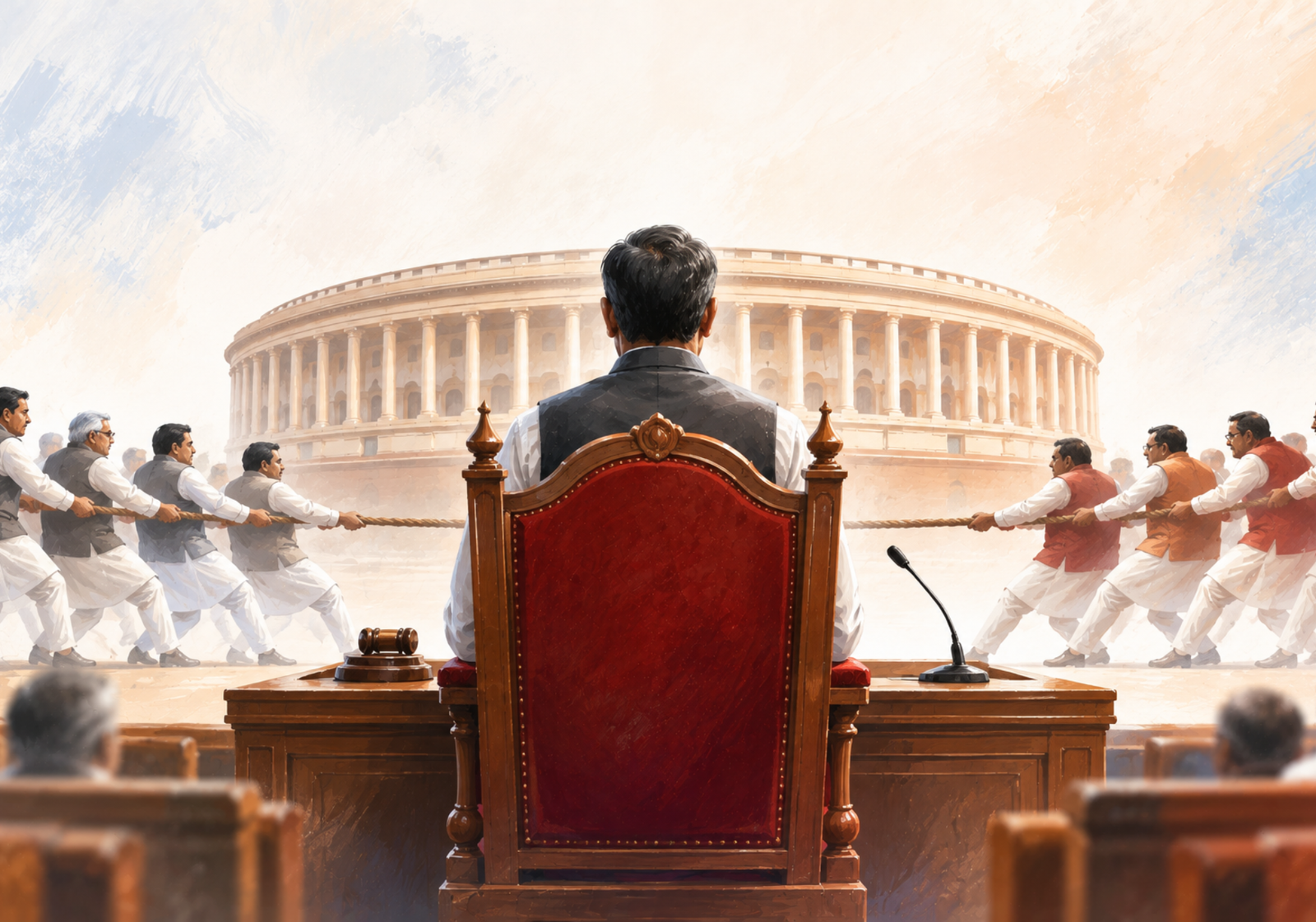
“Internal dissent.” That is what Maharashtra Assembly Speaker Rahul Narwekar called it on February 15, 2024, when he cleared Ajit Pawar’s breakaway NCP faction of any wrongdoing — ruling that turning on party founder Sharad Pawar did not amount to defection, and that the Tenth Schedule, India’s anti-defection law, had itself been “misused” against Pawar. Five weeks earlier, he had used the identical logic to absolve Eknath Shinde’s Shiv Sena faction. In Narwekar’s arithmetic, the side with more MLAs was, by definition, the real party — a formula elegant in its simplicity, and almost impossible to defend as law.
Narwekar may well be right that some of the petitions before him were tactical, filed by a wounded faction hoping the law would deliver what an election could not. He is almost certainly wrong that misuse is where this story ends. In the four years since Shiv Sena first split in June 2022, the Tenth Schedule has been invoked, argued, appealed and adjudicated more often — and with less practical effect — than at any point since the Constitution’s 52nd Amendment created it in 1985.
Three implosions — Shiv Sena, the NCP, and West Bengal’s long-running Mukul Roy affair — have run the same law through the same institutional machinery and arrived, with minor variations, at the same result: the defectors kept their seats, kept their government, and in two of the three cases kept the original party’s name and symbol. The tidy explanation is a loophole in the statute. The less comfortable one is that the law’s designated umpire is structurally incapable of ruling against the side that picked him.
A tribunal with a home team
The Supreme Court settled the constitutional architecture of the Tenth Schedule as far back as 1992, in Kihoto Hollohan v. Zachillhu. The majority upheld the law but made one specific, load-bearing choice: it designated the Speaker of the House — not a court, not an independent tribunal — as the adjudicator of disqualification petitions, ruling in a capacity the judgment itself called that of a “tribunal.” The minority dissented on precisely this point, warning that a Speaker owes his position to a legislative majority and cannot be presumed to sit in neutral judgment over that majority’s own conduct. For three decades, the majority’s confidence in the office and the minority’s skepticism about the officeholder have both been tested, case after case. Every major defection crisis since has supplied fresh evidence for the minority’s side of the argument.
The pattern, and the clock nobody keeps
Look at the sequence rather than any single ruling. In May 2023, the Supreme Court’s own Constitution Bench held that a “legislature party” has no existence independent of the political party, and that a legislature party cannot appoint its own whip — a direct rebuke to the logic Shinde’s camp had used to justify its split. Eight months later, Speaker Narwekar ruled in substance the other way: the Shinde faction was the “real” Shiv Sena, he found, because it commanded the legislative majority when the split occurred, and he declined to disqualify anyone. Weeks after that, applying the same headcount logic, he cleared the Ajit Pawar faction of the NCP. In both cases the sequence favoured the defector: break away, secure enough MLAs to form a government, and let the Speaker’s ruling arrive a year or more later, by which point the “real party” question is close to academic because the breakaway faction is already running the state.
This is not a Maharashtra quirk. The Supreme Court flagged the same incentive as early as 2020, in Keisham Meghachandra Singh v. Speaker, Manipur Legislative Assembly, directing Speakers to decide disqualification petitions within three months and suggesting Parliament consider an independent tribunal instead. Five years on, the Court was issuing the identical rebuke to a different assembly: in Padi Kaushik Reddy v. State of Telangana, it found that the Telangana Speaker had sat on disqualification petitions against ten defected BRS MLAs — filed in March–April 2024 — without issuing notice for more than seven months, doing so only after the matter reached the Supreme Court in January 2025. In its judgment that July, the Court held that a Speaker enjoys no constitutional immunity from judicial review while acting under the Tenth Schedule, and imposed a fresh three-month deadline. An instruction repeated this often, to this many Speakers, across this many states, has stopped looking like an oversight and started looking like a feature.
The steelman, and why it still doesn’t hold
It would be unfair to pretend there is no case for leaving this power where the Constitution put it. Speakers sit inside the House; they understand its internal politics, its whip system, its factional grammar, in a way a judge parachuted in after the fact does not. The Kihoto Hollohan majority itself worried openly about importing judicial review too deeply into a legislature’s internal proceedings, and settled on the Speaker as adjudicator for exactly that reason. And the line the law asks a Speaker to draw — between a legislator who has “voluntarily given up membership” and one who is merely, in Narwekar’s phrase, expressing “internal dissent” — is genuinely difficult to draw from outside the party’s own internal life. A tribunal of retired judges would not automatically get that line right either, and a tribunal whose members are appointed by whoever governs at the time could, in due course, develop the same home-team problem in a different uniform.
But the reform actually on the table does not ask anyone to referee that harder question. It asks only that the decision, whichever way it goes, arrive on a clock that the ruling side does not control. Three months is not a partisan number, and a tribunal need not be asked to rule on who is politically right — only to rule promptly, and to rule before the facts on the ground have already made the ruling irrelevant. That specific, narrower fix has been sitting in a Supreme Court judgment since 2020. Parliament has not acted on it once in the five years since.
Bengal’s cautionary coda
West Bengal shows what happens when courts eventually do step in — and why that is not, by itself, a clean answer either. When the BJP’s Suvendu Adhikari sought Mukul Roy’s disqualification after Roy crossed back to the Trinamool Congress in 2021, weeks after winning his seat on a BJP ticket, Speaker Biman Banerjee rejected the plea, then rejected it again on review. It took the Calcutta High Court, in November 2025, to finally disqualify Roy — the first time an MLA’s membership has been cancelled under the anti-defection law in Bengal’s history, and a rare instance of a constitutional court substituting its own finding for the Speaker’s. Even that ruling did not hold: the Supreme Court stayed it two months later, in January 2026, noting that the electronic material relied on to prove defection would need to be tested carefully “in the present era of artificial intelligence and digital manipulation.” One Speaker sat on the case for four years; the court that finally acted had its own order suspended within weeks.
Narwekar was not wrong that the Tenth Schedule can be misused by petitioners with an axe to grind. But the deeper misuse belongs to the design of the law, not to the litigants who exploit it: a provision meant to punish the legislator who breaks faith with voters has become, case after case, a stopwatch that the ruling side is allowed to hold. The fix does not require rewriting the 52nd Amendment or re-litigating Kihoto Hollohan. It requires Parliament to do something it has so far declined to do at all — read a five-year-old Supreme Court judgment, and act on it. Until then, expect more Speakers explaining, with perfect legal composure, why the team currently in office was the real team all along.