Since mid-2025, India’s Election Commission has been running the most sweeping revision of its voter rolls in over two decades — the Special Intensive Revision, or SIR. It started in Bihar ahead of that state’s assembly election, then expanded nationwide: 12 states and union territories covering roughly 51 crore electors completed a round by February 2026, and SIR exercises are still active in Karnataka, Telangana, Delhi and Punjab through October.
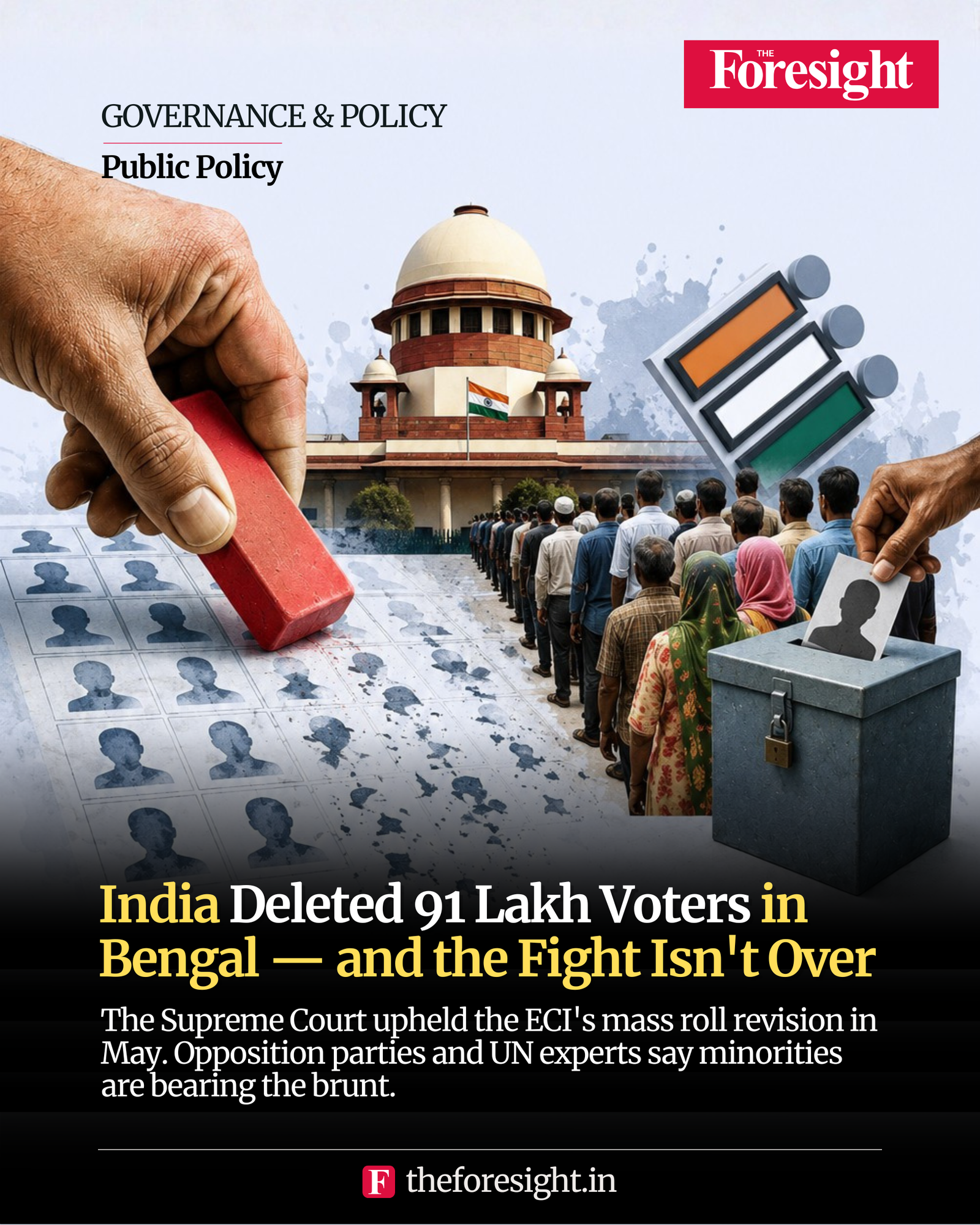
The scale of the deletions is large by any measure. In Bihar, the final roll (released September 2025) showed a net loss of about 47 lakh voters — nearly 6% of the state’s electorate — after 68.5 lakh names were removed and 21.5 lakh added. In West Bengal, ahead of its 2026 assembly election, the ECI removed roughly 91 lakh names, nearly 12% of the state’s pre-revision electorate of 7.6 crore.
The ECI’s official reasons are deaths, relocations, and duplicate entries — and it points to safeguards including a claims-and-objections window and booth-level agents from political parties who sign off on the process. But one part of the process has drawn specific scrutiny: a category called “other reasons,” used to delete more than 84,000 voters in one phase, which the Commission has never publicly defined.
The opposition’s core charge is that the deletions haven’t fallen evenly. Analysis of Bihar’s data found Muslims were 24.7% of voters initially flagged for scrutiny but 32% of those ultimately deleted. In West Bengal, Muslims made up about 27% of the population but nearly 70% of voters flagged for “logical discrepancies” — and in Nandigram specifically, roughly 95% of deleted voters were Muslim, in a constituency where Muslims are about a quarter of the electorate. Three UN Special Rapporteurs wrote formally to the Indian government in May raising the same concern.
The ECI and government reject the framing. On May 27, the Supreme Court upheld the SIR’s legality outright, ruling the Commission acted within its constitutional authority and finding “no flaw” in a process it said protects the “integrity, accuracy and purity” of electoral rolls. Separately, when Leader of the Opposition Rahul Gandhi alleged specific instances of “vote chori” — including claims of over a lakh fake or duplicate voters in Bangalore’s Mahadevapura and 25 lakh fraudulent entries in Haryana — the ECI rejected both, calling the Karnataka claims “incorrect and baseless” and the Haryana claims “unfounded,” and asked him to substantiate them under oath.
Both threads are still live. The Union government only acknowledged receiving the UN Rapporteurs’ letter on July 30 — three months after it was sent — and has yet to formally respond. SIR itself continues rolling through more states this month. Whether it’s cleaning up genuine errors or reshaping the electorate along communal lines depends on data neither side disputes — and a conclusion neither side agrees on.
Sources: News on Air/PIB · The Wire · Deccan Herald · Outlook India · Al Jazeera · The Week · Tribune India · Bar and Bench · NRI Affairs