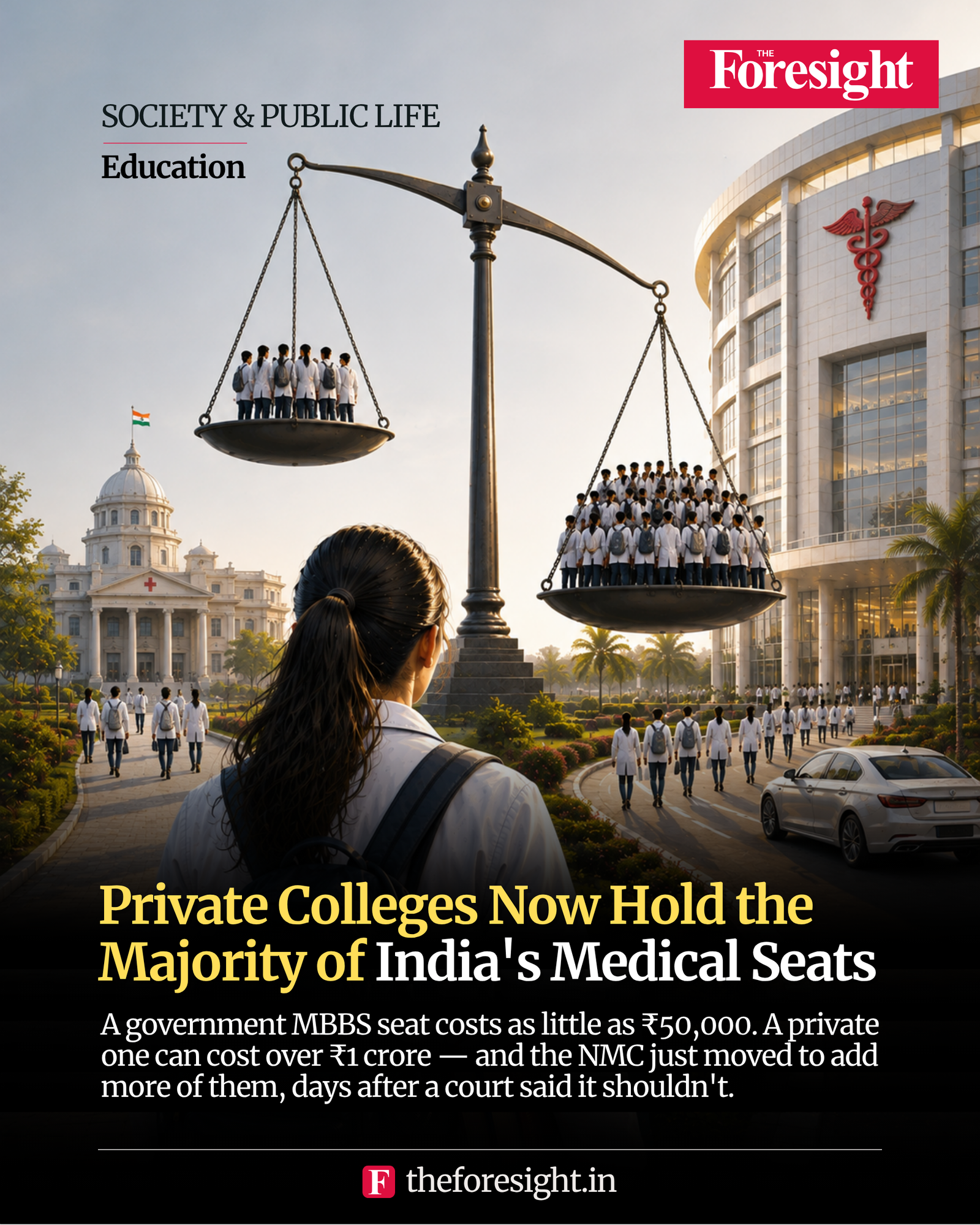
For the first time in India’s history, private medical colleges now hold more MBBS seats than government ones. Of the 1,36,939 MBBS seats available this year across 823 colleges, National Medical Commission data shows 73,643 — 54% — sit in private institutions, against 63,296 in government colleges. The gap is widening fast: of the 9,911 new seats added this year, 7,800 went to private colleges and just 2,111 to government ones.
The seat count matters because of what it costs to fill one. A full MBBS course at a government college typically runs ₹50,000 to ₹5 lakh, depending on the state. At a private college, the same degree can cost ₹45 lakh to over ₹1 crore — 10 to 20 times more, even before factoring in “management quota” seats that can run even higher. For the roughly 22-23 lakh students who registered for NEET-UG this year, competing for those 1.37 lakh total seats, the difference between clearing the cutoff for a government seat and settling for a private one is often the difference between an affordable medical education and a life-altering debt.
That expansion hasn’t obviously fixed India’s doctor shortage where it’s felt hardest. As of the government’s most recent Rural Health Statistics report, Community Health Centres in rural India were short more than 17,500 specialists — including nearly 4,500 physicians — a vacancy rate of roughly 80%. More seats have not automatically meant more doctors willing to work in underserved areas — a structural mismatch between where medical graduates are trained and where they eventually practice.
The story has taken a sharper turn in recent months. In January 2026, the NMC’s board voted to scrap its own 2023 rule that had restricted new medical colleges to non-profit (Section 8) entities. Weeks later, on January 28, the Bombay High Court pushed back — upholding that same non-profit rule and warning that allowing corporate, profit-driven ownership risked creating monopolies and inflating fees further. The NMC pressed ahead regardless: on July 8, it issued a formal gazette notification opening medical-college ownership to for-profit companies, including under new public-private-partnership models — the same change the court had just ruled against. The Indian Medical Association and the Federation of All India Medical Associations have both publicly flagged the commercialisation risk.
The unresolved question sitting underneath all of it: as India adds medical seats faster than ever, is it building a bigger doctor pipeline, or a more expensive gate that fewer families can afford to pass through?
Sources: National Medical Commission 2026-27 seat matrix, via Medical Dialogues and Careers360 · ETV Bharat, “NEET-UG 2026: Over 1.39 Lakh MBBS Seats Up For Grabs” (Aug 5, 2026) · NTA official NEET-UG 2026 registration data · Rural Health Statistics report, Ministry of Health and Family Welfare · Medical Dialogues, Bombay HC ruling (Jan 28, 2026) and NMC gazette notification coverage (Jul 8, 2026) · CollegeDekho, Vedantu, Matrix Edu (fee-structure comparison)