
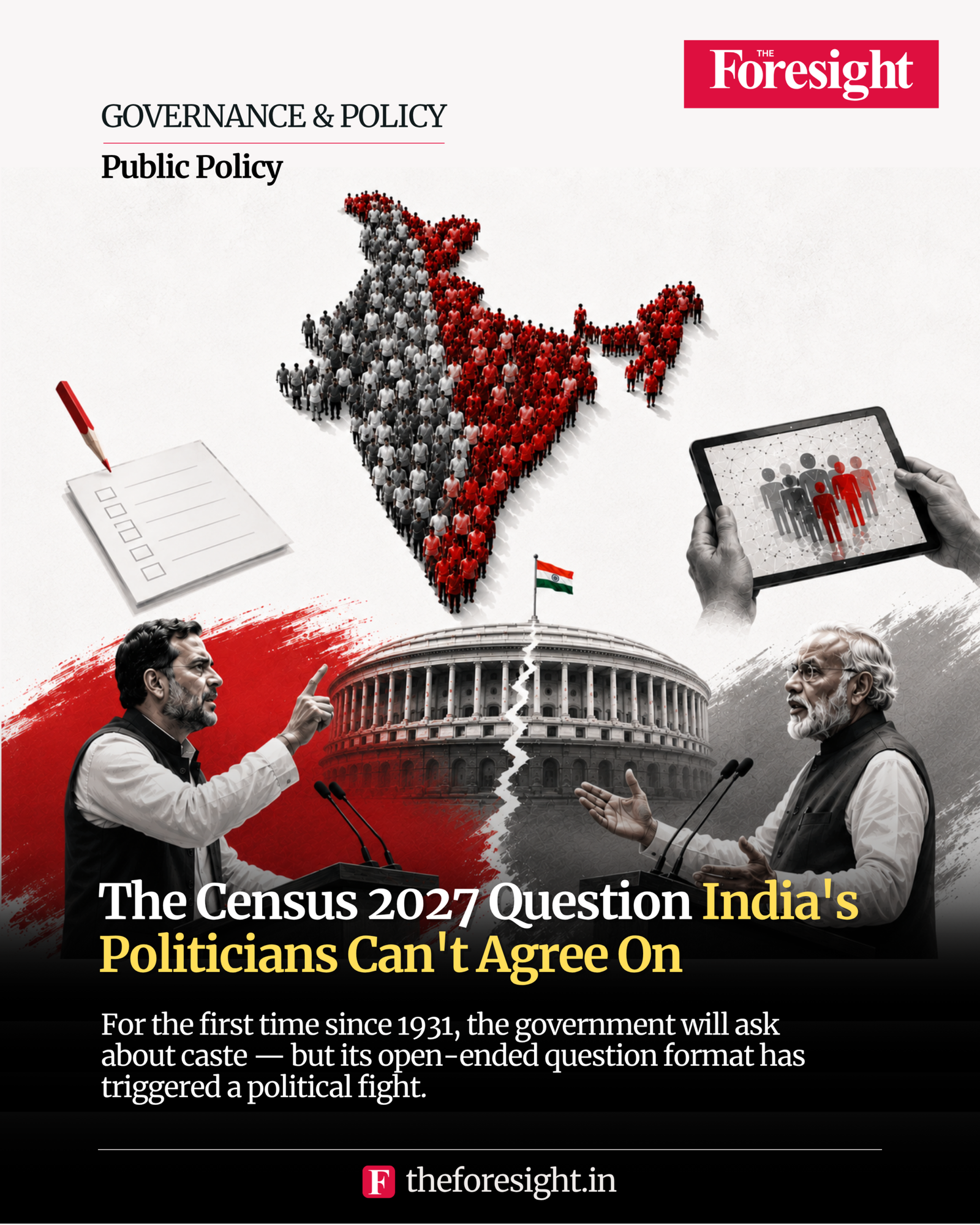
For the first time since 1931 — 95 years — India’s census will count caste. Census 2027, India’s first fully digital census, is being run in two phases: a house-listing and housing survey from April to September 2026, followed by population enumeration in February 2027 (with some snow-bound regions completing it in September 2026). It’s a genuinely massive undertaking: a ₹11,718 crore budget, roughly 30 lakh field staff, and enumerators recording data through a mobile app instead of paper forms.
The last time India’s census recorded caste was in 1931, under British colonial rule. That raw data later became the material the Mandal Commission drew on in 1980, extrapolating from it to estimate that Other Backward Classes made up 52% of India’s population — a figure that became the empirical foundation for the Commission’s recommendation of 27% reservation for OBCs in government jobs and education, a policy actually implemented only in 1990. Independent India never repeated the exercise itself; the Constitution’s framers worried caste enumeration would entrench division rather than reduce it, and government policy since has leaned on decades-old projections and NSSO survey estimates instead of a real headcount.
The fight underway right now is not about whether to count caste — both major parties say they support that — but how. The questionnaire — a 40-question form notified on August 14 by Registrar General Mrityunjay Kumar Narayan — lists caste as question number 10, reading simply “Scheduled Caste (SC)/Scheduled Tribe (ST)/Caste.” There’s no dropdown, no tick-box, no pre-fixed list: enumerators are instructed to record whatever caste name a respondent gives, exactly as stated, in an open column. On August 25, Leader of the Opposition Rahul Gandhi and Congress president Mallikarjun Kharge wrote directly to PM Modi calling this “misleading,” warning that the same caste recorded under different spellings, sub-caste names or local variants could fragment into what they called “millions of castes” in the data — potentially making the results unusable. They want the government to scrap the current form and adopt the model used in Bihar’s 2023 caste survey (which counted against a government list of 214 castes) or Telangana’s 2024 survey (a detailed 57-question door-to-door exercise covering 96.9% of the state).
The government’s defense is technological: officials say digital collection paired with AI-assisted classification can sort through open-ended, free-text caste responses at a scale and accuracy that wasn’t possible in 1931 or even in Bihar’s largely manual 2023 count. The BJP has dismissed the Congress’s alarm as political “panic,” with Home Minister Amit Shah noting the party itself backed Bihar’s caste survey when in power there. What’s actually being contested is whether an AI can clean up messy, self-reported data as reliably as a fixed list can prevent the mess in the first place — a technical question with enormous political stakes, since whatever numbers come out of this will likely reshape reservation policy for a generation.
Sources: ThePrint, Republic World, Down To Earth, Deccan Herald (Census 2027 questionnaire notification, Aug 14, 2026) · The Wire, India TV News (Kharge-Rahul Gandhi letter to PM Modi, Aug 25, 2026) · ANI News (Bihar/Telangana model demand; BJP’s response) · Vision IAS, India TV News (1931 census history, Mandal Commission) · NewsX (Bihar, Karnataka, Telangana caste survey comparison) · The India Forum (Telangana survey methodology) · Wikipedia, Deccan Herald (Bihar caste-based survey 2023 data)