
In May 2025, Wipro handed out letters of intent to about 250 engineering graduates. By January this year, most of them were still waiting for a start date. NITES, the technology workers’ body, wrote to the labour ministry asking Wipro to tell these young engineers something, anything, about where they stood. Around the same time, Wipro trimmed its own hiring target for the year from 10,000 freshers to 7,500. None of those 250 had done anything wrong. They had cleared placements, signed contracts, and waited for a company that no longer wanted as many of them as it once did.
Delhi is having a very different argument this year. It is about whether a degree still means anything, and whether India should be teaching skills instead of handing out diplomas employers no longer trust. Nobody in that argument has mentioned Wipro’s freshers, which is odd, because every side of it assumes the same thing: that a young Indian with the right paperwork, or the right training, will find a rung to stand on. Those 250 graduates had both. There was no rung.
The numbers cut both ways
Start with the figure used most often against degrees. According to the State of Working India 2026 report from Azim Premji University, unemployment stands at around 40 per cent for graduates aged 15 to 25, and about 20 per cent for graduates aged 25 to 29. Only 7 per cent of young male graduates land a permanent, salaried job. About half find some kind of work within a year of calling themselves unemployed.
Taken alone, that looks like an indictment of the degree, and it probably is, in part. But tucked inside the same report is a number that should embarrass everyone currently arguing about curricula: graduate unemployment in India has hovered between 35 and 40 per cent since 1983. Four decades. Several governments, several waves of reform, more than one national skilling mission. The number has barely moved. If the wrong kind of education were the whole story, forty years should have settled it one way or another by now. What did change, over those decades, is how many graduates there are to begin with — enrolment climbed steadily even as the unemployment rate stayed almost exactly where it was. The university’s own researchers put it plainly: the rise in graduates has not been matched by a rise in graduate jobs. Whatever that is, it was here long before AI, long before edtech, long before this year’s headlines.
Somebody chose fewer freshers
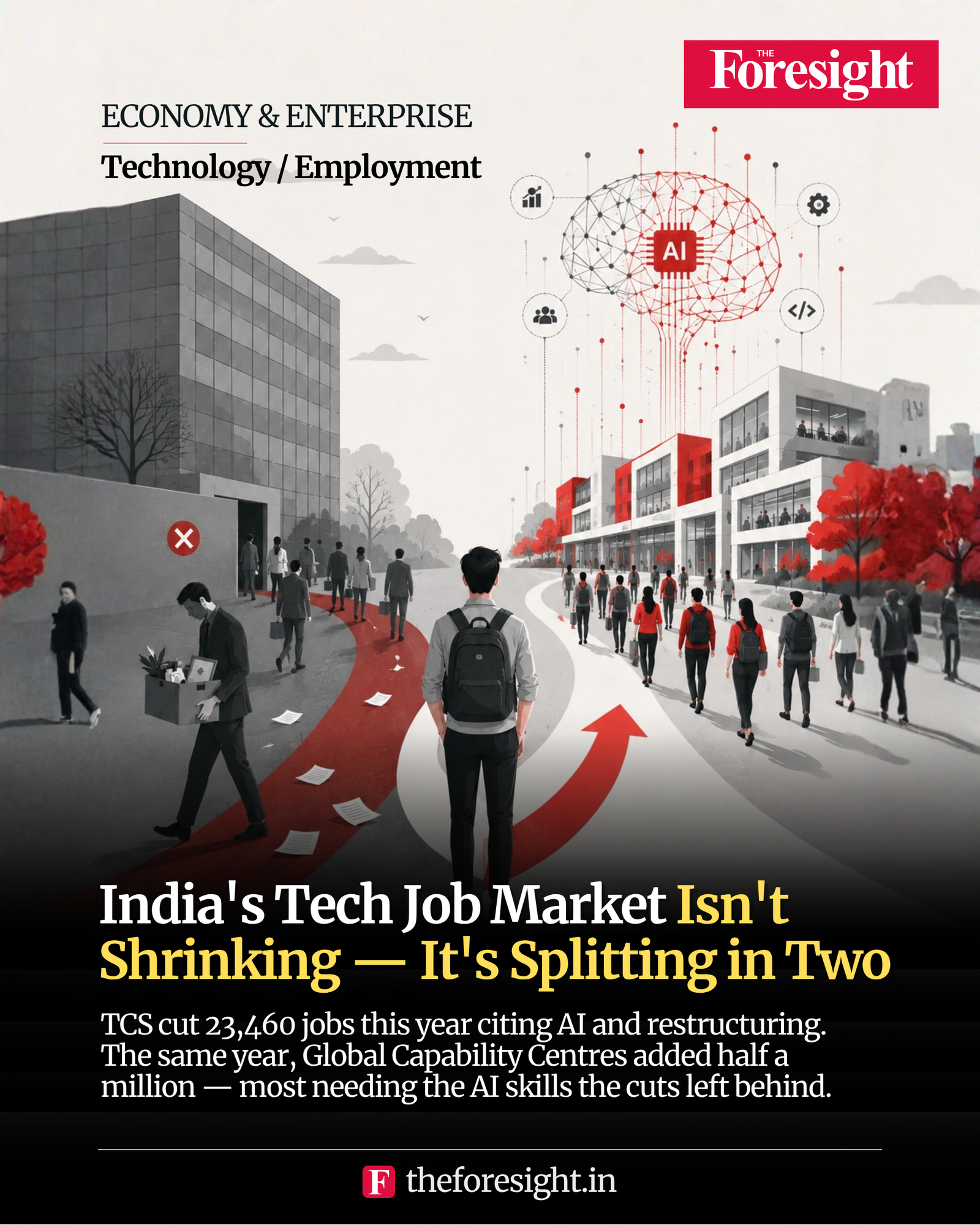
What has changed this year is who is making an old problem worse, and the reasons being offered for it. Tata Consultancy Services started the financial year with 607,979 employees and ended it with 584,519 — a decline of 23,460. The company also disclosed spending Rs 1,388 crore on the restructuring itself, and its attrition rate climbed to 13.7 per cent. TCS says the fall came largely from a tighter bench policy and voluntary exits among mid-to-senior staff rather than from freshers, and that it made about 25,000 campus offers this year, on track to keep hiring roughly 40,000 graduates annually — only slightly down from around 44,000 the year before.
TCS’s own chief executive went out of his way to deny, when the cuts were first announced, that artificial intelligence was behind them. “This is not because of AI giving some 20 percent productivity gains,” he said, adding that the real driver was “where there is a skill mismatch, or where we think that we have not been able to deploy someone.” Other reporting on the same restructuring points to a mix of causes — slowing global IT spending, tighter client budgets, and a broader industry pivot toward generative AI and automation. Whichever explanation is closer to true, what the company is actually building looks less like the old pyramid, a wide base of cheap freshers holding up a narrow top, and more like a diamond: thicker in the middle, thinner at the base.
HCL Technologies has been doing something similar in plainer language. It is now offering elite freshers with AI skills annual packages of Rs 18 lakh to Rs 22 lakh, three to four times what a regular fresher earns, while hiring far fewer people overall. Its chief people officer described the approach as hiring fewer people, but paying more for the right skills. That is not a slogan aimed at graduates without AI skills. It is a description of who is no longer being hired at all.
Take every company entirely at its word, and nothing changes about the arithmetic. A diamond is narrower at the bottom than a pyramid. However you get there, fewer first jobs exist this year than existed two years ago.
A sixfold jump will not close a forty-year gap
None of this means skills do not matter. The India Skills Report 2026, put out by the assessment firm Wheebox, found postings for AI and machine learning roles up sixfold over the year, and employability running at 80 per cent for computer science and IT graduates against about 55 per cent for arts graduates. At the very top of the market, the right skill clearly still opens a door.
But a sixfold rise from a small base does not bring down an unemployment rate stuck near 40 per cent for millions of young graduates, and it does nothing for the fresh batch leaving campus this year. The skills-versus-degrees argument likes to picture a young Indian standing at the foot of a ladder, weighing up which shoes are right for the climb. What happened to those 250 graduates at Wipro is closer to the truth: shoes on, contract in hand, and no rung to put a foot on.
India does not need one more verdict on skills versus degrees. It needs someone with the power to answer a harder question: who is responsible for rebuilding the rung that just disappeared. Nobody has asked it yet. Until somebody does, the ladder keeps getting shorter, no matter what shoes anyone is wearing.