
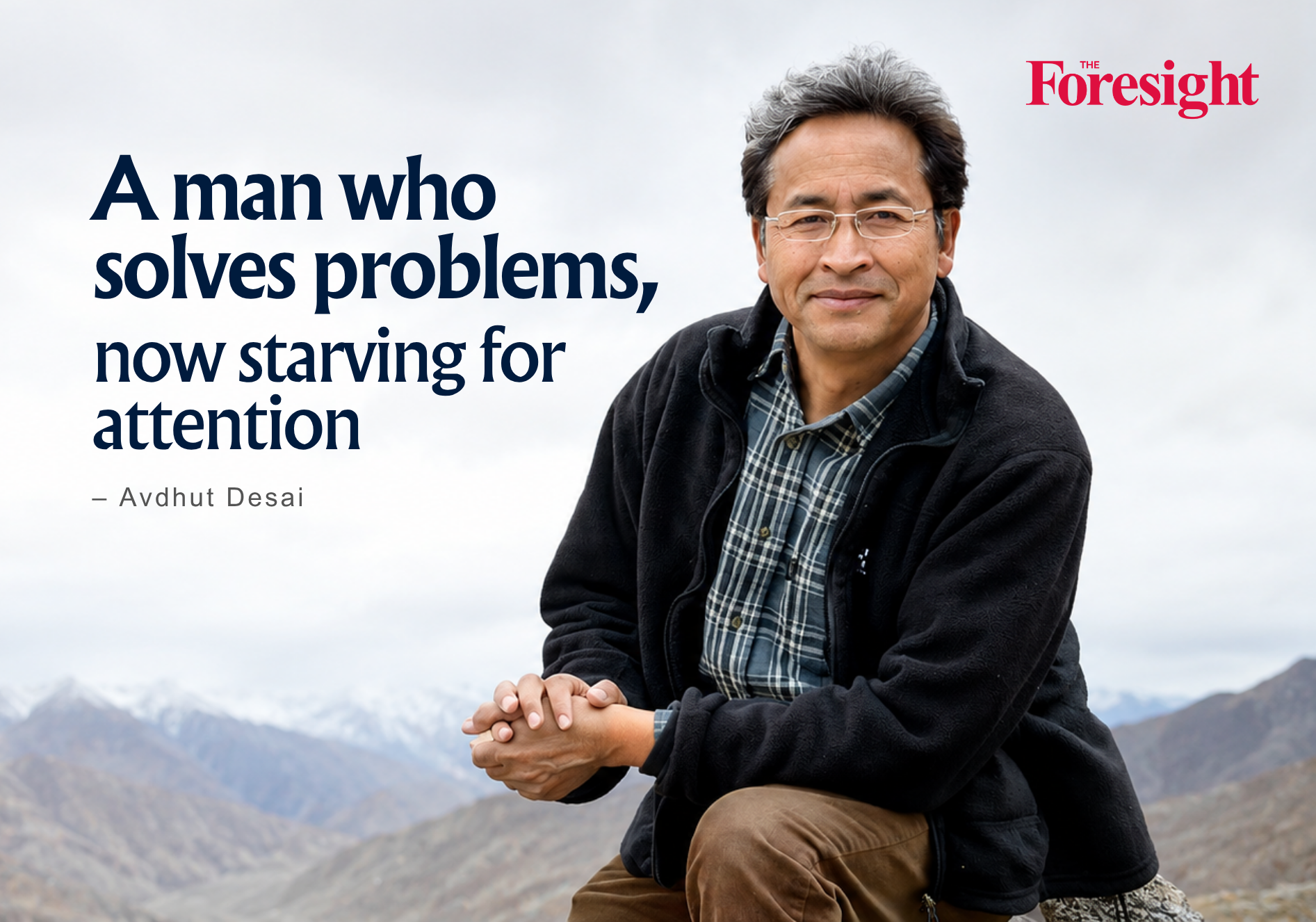
There is an irony in the fact that a man who once solved a Himalayan village’s water crisis by freezing a fountain into a cone of ice — no ministry’s approval needed — must now deny himself food in a Delhi park just to get his government to listen. Sonam Wangchuk, the engineer and education reformer known for his ice stupas and his alternative schooling model in Ladakh, is eighteen days into his sixth hunger strike since 2023. He has lost more than eight kilograms. His blood sugar has repeatedly dropped to unsafe levels. A petition is now before the Delhi High Court asking whether the state should be allowed to keep him alive against his own wishes — because the institutions that could have resolved this through ordinary means have not.
The immediate cause of this fast is almost beside the point. Wangchuk began it on 28 June at Jantar Mantar, in solidarity with a Gen Z-led protest over irregularities in the NEET-UG medical entrance exam, demanding the education minister’s resignation. That is not even his own cause. His real grievance, a decade in the making, is Ladakh’s unresolved constitutional status — the statehood and special protections promised, at least implicitly, when the region was made a Union Territory without a legislature in 2019. That two separate failures of governance have landed on one man’s body at the same time is not a coincidence worth a footnote. It is the story.
A pattern, not a one-off
Count the record instead of the rhetoric. This is Wangchuk’s sixth fast in three years. In between, there was a Pashmina march stopped at Delhi’s border, a fourteen-day hunger strike in Leh last September, months in Jodhpur jail under the National Security Act — a law meant for people who threaten national security, not citizens asking the government to keep its word — and, after his release, a habeas corpus plea that had to reach the Supreme Court before anyone in government responded.
Look at the pattern and a shape emerges. Talks between the Centre and Ladakh’s two main civil society bodies, the Leh Apex Body and the Kargil Democratic Alliance, have been going on since 2021 under a High-Powered Committee. They have started, stalled and restarted — but each restart has come only after a fast, a march, or worse. The September 2025 violence in Leh, in which four people died in police firing, was followed within two days by Wangchuk’s arrest. The Delhi High Court is hearing his current case only because a private citizen approached it, not because the government stepped in on its own. Even Wangchuk’s own softer tone after his release in March — his comment that “talks are a give and take” — was answered not by the government but by Ladakh’s leaders, who publicly overruled him and called their demands non-negotiable. Through much of this, the state has not so much taken part in the conversation as waited to be summoned to it, usually by a court.
A fair hearing for the government’s caution
The government’s caution here is not baseless. Ladakh is a border region bordering both Pakistan and China, and any change in its administrative status raises genuine questions about defence planning, land use and long-term security that a government cannot simply wave through. The ruling party leader’s public criticism — that the protests risk delaying infrastructure important to national security — reflects a real tension between local self-rule and strategic planning, not manufactured obstruction. On the examinations front too, the government did conduct a re-test of NEET-UG in June, some sign of a response, even if the protesters feel it falls short. Both positions deserve to be argued out properly, in Parliament and in committee rooms, rather than dismissed.
Courts are not a substitute for dialogue
But caution does not require silence. Holding a position is not the same as refusing to discuss it. What keeps repeating across six fasts is a government that treats dialogue as a last resort rather than a first duty — where courts are asked to force what ordinary politics should have offered on its own, and by the time a minister finally speaks, the story is no longer about Ladakh’s future or exam integrity, but about whether a fifty-nine-year-old man survives the week.
This is not new to one government alone. India has seen both kinds of response before. Anna Hazare’s 2011 fast against corruption was met by a government that moved quickly, worried about the crowds it was drawing and the ground it was losing. Irom Sharmila’s sixteen-year fast against the Armed Forces Special Powers Act in Manipur met the opposite response — a government that simply waited her out, treating her hunger as a medical problem to manage rather than a political demand to answer. Wangchuk’s case looks closer to the second story than the first. What has moved fastest through this whole episode is not policy, but the machinery around his survival — health bulletins, a force-feeding petition, a court hearing. The political question underneath has moved at the same slow pace it has for six years.
What this teaches everyone else
The danger of letting this become routine goes well beyond Ladakh or exam reform. It teaches every citizens’ group without a Magsaysay Award, a Bollywood origin story, or the means to reach the Supreme Court that the government’s attention is earned by spectacle, not by the merit of the demand. A state that responds mainly to virality or body counts is teaching its most constructive citizens — the ones who show up with solutions, not just complaints — that starving in public is the most reliable way left to be heard. That is a poor reward for the patience such citizens have shown until now.
What should change
None of this is an argument for handing over every demand attached to a hunger strike; governing by whoever fasts the longest is no better than governing by neglect. It is an argument for building, deliberately, the everyday habits of listening — fixed timelines for committee talks, real accountability when ministers sit on a file, a working rule that a citizen’s petition gets a date on the calendar long before it needs a doctor’s warning. Dialogue should be something the state offers as a matter of course, not something a court finally has to order.
Sonam Wangchuk built his reputation on solving problems, not just naming them — water pulled out of winter air, a school that taught differently, a movement that stayed peaceful for years. What he is showing now, against his own wishes, is a harder and sadder lesson: how much a citizen has to give up just to get the state to open the door.